Good Experimental Music: June 2026
This time around: 80s space noise, woodwinds in the woods, the world's oldest playable organ, and solo guitar intended as "a revolt against polished civilization." Plus a ton more!

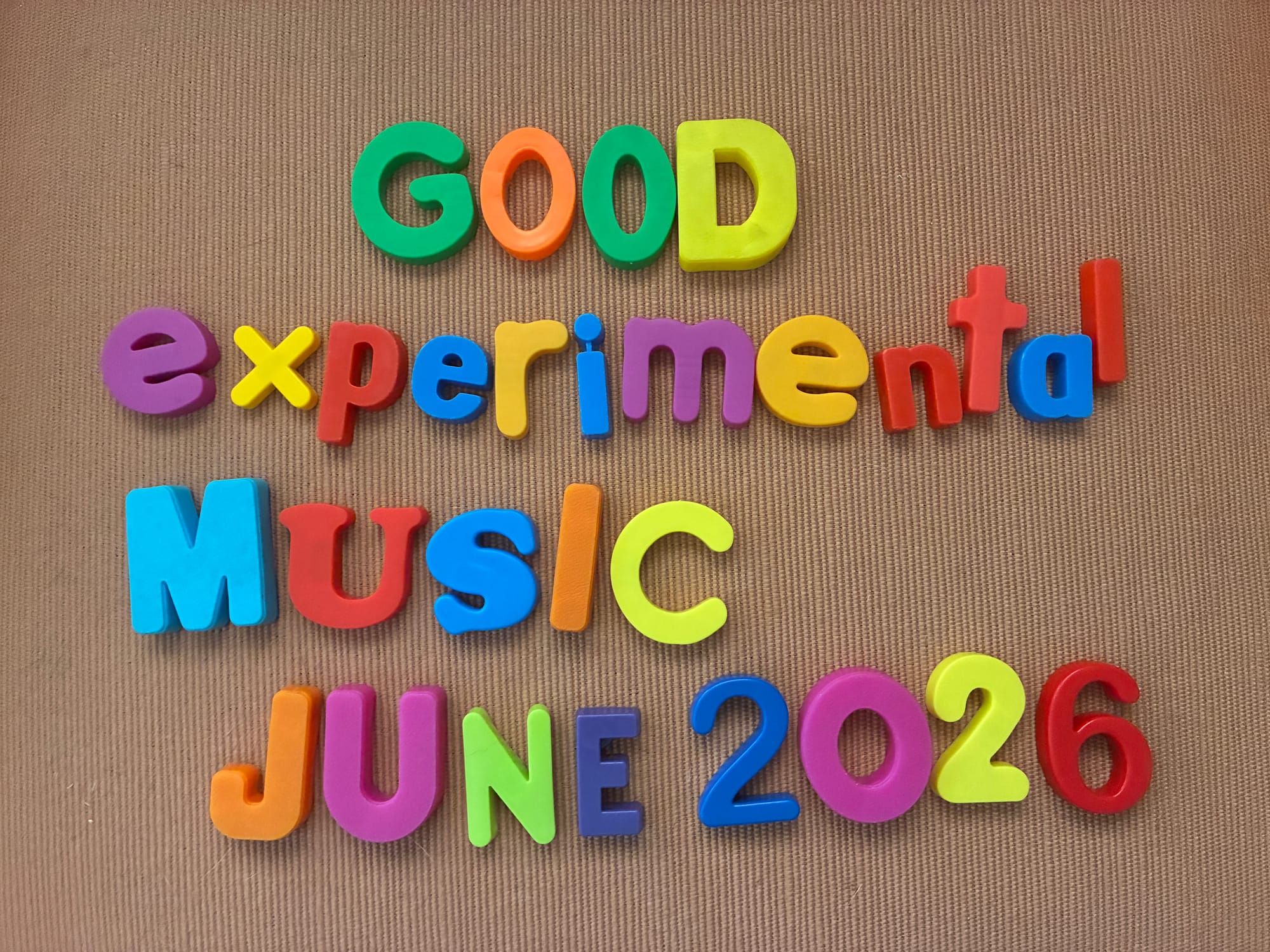
Welcome to the our monthly roundup of Good Experimental Music! This time around we have 80s space noise, woodwinds in the woods, the world's oldest playable organ, and solo guitar intended as "a revolt against polished civilization." Plus a ton more! We present them to you in alphabetical order by artist. (And scroll down for a bonus list of 12 more June releases we dig!)
This post is free for anyone to read, so please pass it around if you dig it!
Attorneys General
at Ftarri, Tokyo (w/Tetuzi Akiyama, Elico Suzuki)
at Pan-Pan, Birmingham, UK (w/ Mark Sanders and Mark Hanslip)
at Horse Hospital, London (w/Tara Cunningham, Mike O'Malley, Alex McKenzie)
(Headache Journals)
The project that Matthew Byars calls Attorneys General has a simple concept. He invites musicians to improvise live, feed their sounds through his mixer, and reshapes and reforms what they're doing as it happens. If you're familiar with what Martin Swope did with Mission of Burma (Byars is!), you have a reference point for Attorneys General, but Byars works with a wide range of contributors rather than a single band. On these three live albums made in Japan and the UK, he's given quite different material: guitar and piano in one case, drums and sax in another, two guitars and a sax in the third. Of course, what the players play is the main factor in what you hear, and these are some heavy players, including guitar legend Tetuzi Akiyama and current Sleeves guitarist Tara Cunningham. I'm hesitant to describe much of the music, as the point seems to be less the results than the process. So try listening to the process: the way each player responds to each other, the way Byars reworks those conversations, and the way each recording feels like a true experiment, an exercise in seeing what can happen when creative people get to be creative together.
Chad M Clark
Hex Infector
(self-released)
I'm not sure I can describe Hex Injector any better than guitarist Chad M. Clark does on his Bandcamp page: "a revolt against polished civilization and a return to the electrical wilderness." It definitely sounds a lot more like that than someone playing guitar, which is part of why it's so fascinating. Now, Clark's past work is varied enough that this isn't the first time he's made a guitar produce non-conventional sounds, but Hex Injector feels like a special case of "how the hell did he do this?" Clanging, erupting, firing, and crashing, the two tracks here are splendorous exercises in sonic destruction. It's an onslaught in high-definition, as you can really hear each piece of the noise clearly and distinctly. I'm tempted to compare harrowing music like this to post-apocalyptic scenarios, but I'd encourage you to turn off the part of your brain that needs images and let this be pure sound, drilled directly into your ears.
Chris Corsano and Tashi Dorji
Live at Ritual Botanica
(Feeding Tube)
Camila Nebbia and Chris Corsano
Six or Seven Ways Towards Becoming Undone
(Relative Pitch)
The Chris Corsano name is a trademark of quality. I can't think of a record he's been involved in that isn't worth listening to. But the ever-creative drummer is extra special in the duo format, most notably in recurrent pairings like his co-ops with Paul Flaherty, Bill Orcutt, and Mick Flower. His limited/one-off duos cook too, and two recent releases offer a good chance to see how his approach varies and molds to fit two quite different players. With guitarist supreme Tashi Dorji, he's faced with noisy textures that can morph quickly, so he's primarily doing a lot of high-speed rolling and slapping on Live at Ritual Botanica. Dorji himself is a duo master, primarily in his group Manas with drummer Thom Nguyen, so just on paper I'd expect this to be a masterpiece, and I'd be right. Every moment is filled with something to dig into, but don't leave before the closer, a two-minute blast called "Cross" that seems to both im- and ex-plode. Corsano's session with Nebbia is a wholly other beast, and not just because it's twice as long. I hadn't heard Nebbia before this (dumb of me consider how much there is to hear!) but I was instantly bowled by her playing on Six or Seven Ways Towards Becoming Undone which tears at the air for longer stretches that I can even just stand up. Here Corsano strikes me that as more of a backer for Nebbia than he was for Dorji, pin-pricking his snare so it accents Nebbia's runs. It's a wise tactic, as the duo manage to follow each other while Nebbia retains the lead, a kind of neat mobius-strip trick that makes Six or Seven Ways quite replayable.
Maya Dunietz & Solistenensemble Kaleidoskop
The Sound of Difference and Connection
(ORTHODOX)
If you've ever heard John Cale and Terry Riley's Church of Anthrax, you know that few seconds of buzzing before the bass riff comes in? Imagine that buzz made into an album itself, and you're not far from Maya Dunietz & Solistenensemble Kaleidoskop's The Sound of Difference and Connection. There's a much more complicated explanation for what's going on inside this music, and I don't understand most of it. But I do really like the idea that this is a "a piece that listens to itself, breathing through the bodies of its players." Written by Dunietz and performed by SK, a 10-piece ensemble of violins and cellos, this album – presented in three parts – gets buzzin' and never stops. At times it feels nearly static, but mostly it's jetting forward, wavering in and out of focus via changes in pitch and volume, but always twirling, twirling, twirling towards freedom. I don't mean to take this record lightly, as it's quite dense and filled with sonic sustenance, but it's also just fun to brain-hum along to The Sound of Difference and Connection's halo of flies.
F/i
Invisible Men
(Birdman)
F/i, a kind of space-noise project centered on Richard Franecki and sometimes including Brian Wensing and Steve Zimmerman, was impressively prolific in the 80s and early 90s. Discogs lists over 20 releases during that time period. Franecki and Zimmerman moved on to the band Vocokesh in the early 90s, but some F/i releases (archival and/or reissues) have trickled out in the decades since. I haven't heard a ton of those, but I really want to, now that I've heard Invisible Men, a super-compelling collection of mysterious missives that feel beamed in from some other stratosphere. Weird rumblings drift in and out of each piece, sometimes coating the proceedings in a tantalizing haze, other times (see "Untitled VI") drilling at the stereo space as if the F/i gun was pointed right at your forehead. The outer space associations are easy to make with music this alien and wave-like, but F/i's sound is a lot bigger than the observable universe. Expand your mind to match it.
Judith Hamann & James Rushford
Midmeste
(Black Truffle)
You should read the text on their Bandcamp page to get the full gist of how Australian artists Judith Hamann and James Rushford made Midmeste. But I'm fixated on the fact that one part of their sound comes from "the organ of the Basilica St Valere in Sion, Switzerland—the world’s oldest playable organ, built in the early 15th century." I'm not sure I could pick it out in the mix of these two 20-minute tracks, but I it's a cool reference point for orienting yourself to this music, which sounds reverent, austere, even ancient. At times the slow strains of cello and pipe organ seem to greet you as you walk through the dark, cold halls of some cave-like church (or church-like cave); at others, this feels like it's being played right in front of you, with Hamaan and Rushford intently letting their drones flow like they're channeling a river. Midmeste is not super far from the pair's work in the trio Golden Fur (with Sam Dunscombe), but it's also not like anything else I've heard lately, seeming to freeze time while simultaneously traversing walls.
Kohoutek
Akvoturo
(Carbon)
One nice thing about doing this column on my own is that I don't have to be as worried about "conflicts" as I was at Bandcamp Daily. I can write about anyone I want here as long as I tell you what's up, and that even includes a release to which I contributed words on the very page from which you can purchase it. I've known Scott Verrastro and his rotating collective Kohoutek for a long time – shared stages with them, hung out with them, written about their music, and probably more. So I'm biased as hell, but I met them all through music, not before it, and I liked what I heard before I liked who I met. Anyway, disclaimer over: Akvoturo is a new and great step in the Kohoutek journey, especially the opener "Pluvobaro," which starts like a subterranean gamelan party, then melts perfectly into the familiar Kohoutek psych-out of "Innundo." I could keep describing from there, but I'd rather you just listen to find out the what/whens, and tell you instead that Akvoturo has the shape of a jam but the atmosphere of a massive storm cloud with a mountain pushing through it, so big and heavy throughout that you'll need to keep your eyes closed while it stretches your ears.
Organic Produce
Vegetal
(Variable)
Emmet Martin lives in Portland, so I imagine he gets out in nature a decent bit (especially if he likes rain). Vegetal, his new tape under name Organic Produce, sounds like an audio diary of him walking around in the woods, playing flute and clarinet while all kinds of nature noises cascade around him. I don't think that's what actually happened, and I also think the music on Vegetal is a lot deeper and more complex than what that scenario would suggest. But it's a nice thing to imagine while listening to the five tracks here, which have a sense of both serenity and exploration, plus names like "Journey into the Wind," "Box Twig," and "Wood Shards." The former opens the album as a 20-minute trek into Martin's woodwind manipulations, and could've worked as a release on its own. But the remaining four shorter pieces are just as compelling, especially closer "Devotion & Refuse," a static-laden field of oscillating tones that sounds like dipping your head into an accordion, which I mean as a compliment. (Btw, Emmet is also in Water Shrews, whose music you should acquire).
Aaron Russell and Sandy Ewen
Dissectologists
(Sedimental)
For now, I'm gonna delay the explanation of how, and just say the atmosphere of Dissectologists hooked me, made me feel like I was in some kind of new state, immediately. The air that Aaron Russell and Sandy Ewan create with guitar and electronics on these four tracks, all recorded in different locales across different years, mesmerized me instantly. Maybe it's simply the pace, the way their electronic beds and slow guitar plucks seem to pull time into a place where it will not be proceeding as fast anymore, thanks very much. Anyway, I defy most people open to this kind of sound not to be frozen by the duo's restrained non-verbal musings, played as if they've are gradually being pulled up through a light beam into the heavens (or maybe a UFO into space). Russell and Ewan have both made some incredible music, together, separately, in Weird Weeds, and much more, so the quality level of Dissectologists is no surprise. But I think the way it snares me always will be.
Ebaugh / Diaz / Meanstreetz
Ryan / John / Mike : Live at Coaxial Arts 12/28/25
(Already Dead)
Here's a trio of Californian improv players I was unfamiliar with. Apparently LA drummer Mike Meanstreets and San Diego saxophonist Ryan Ebaugh have worked as a duo for a while, but for this session Meanstreets took on electronics and their Bay Area pal John Diaz grabeed the drum seat. The three got together to musically workout a bit, and 23 minutes of said sweat session appear on Ryan / John / Mike : Live at Coaxial Arts 12/28/25. I'm not sure if this is the whole performance from that date, but it's certainly enough, filled with energetic playing that sits mostly in the realm of ecstatic free jazz, but has its own flavor. This is partially due to Meanstreets coating the other two in sheets of electronic fervor, but it also comes from the fact that the three seem so comfortable and unpressured that its like hanging out with them while they shoot the shit. But don't be fooled into thinking this is a dorm hang or something (though I love dorm hangs, what I remember of them at least). There's tension and urgency in a lot of the trio's playing, leavened beautifully by assured confidence that makes Live at Coaxial Arts a tasty trip.
12 MORE GOOD EXPERIMENTAL MUSIC RELEASES FROM JUNE
Olivier Alary
Vestiges
(LINE)
Félicia Atkinson
Sans Visage
(Viernulvier)
Henry Fraser
Pneuma
(Kou)
M. Geddes Gengras
Guest List
(Hausu Mountain)
Alex Zhang Hungtai
Orion/Mother
(American Dreams)
Lifted
Movie
(Outside Time)
Josh Mason
Kicking a Dark Horse
(Greyfade)
Secret Places of the Lion
Saturn Fern
(Not Not Fun)
Booker Stardrum and Evan Shornstein
OOPS!
(Sudden Quarterly)
Visible Light
Sierra de Luquillo
(Permaculture Media)
Drew Wesely / Laura Cocks / Camilo Ángeles / Lester St. Louis / Carlo Costa
A Fine Chance for Permanence
(Dinzu Artefacts)
Otomo Yoshihide & Kei Matsumaru
Shutsumin
(Trost)