
Good Experimental Music: July 2026
This time around: guitar and banjo essays, vocal drones, a meeting of four improv stalwarts, and instruments crafted out of abandoned plows.

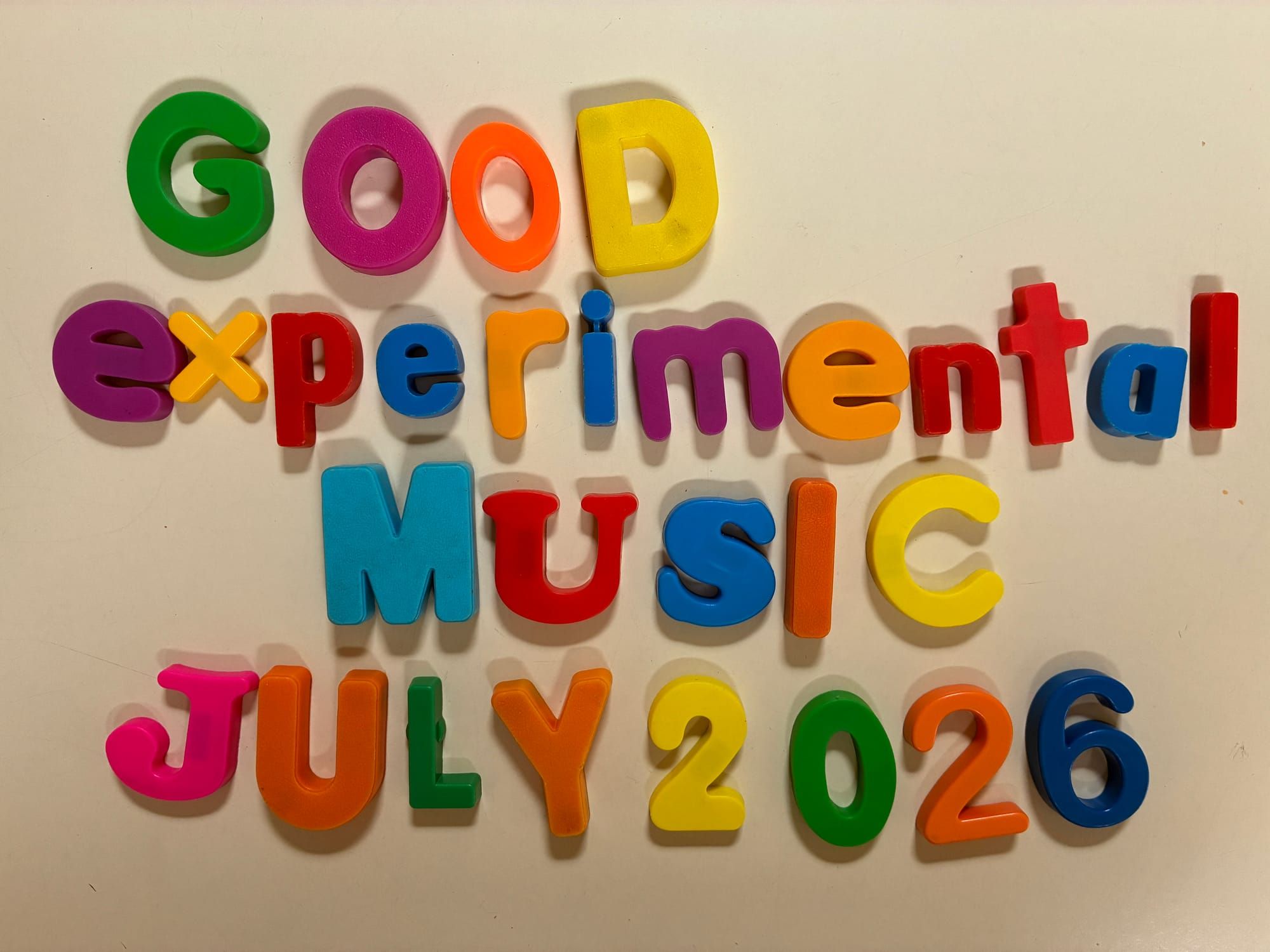
Welcome to the our monthly roundup of Good Experimental Music! This time around we have guitar and banjo essays, vocal drones, a meeting of four improv stalwarts, and instruments crafted out of abandoned plows. Plus a ton more! We present them to you in alphabetical order by artist. (And scroll down for a bonus list of 10 more July releases we dig!)
This post is free for anyone to read, so please pass it around if you dig it!
Lorena Alvarez & Alejandro Palacios
Jardin Giratorio
(Not Not Fun)
Some of the tracks on Lorena Álvarez and Alejandro Palacios' second tape for Not Not Fun strike me as cosmic nursery rhymes, like songs you'd use to get your baby to sleep if you lived on a space shuttle. That comes primarily from Álvarez's Rhodes piano (I think - I'm not an expert in the instruments used here), which gives everything the duo does a slo-mo drift, a feeling of weightlessness. Add Palacios' guitar and his oddly disorienting trombone, and Jardin Giratorio (Spanish for "revolving garden") becomes a waking dream, making sonic sense even when it sounds like it shouldn't. On the surface you could even call it "easy listening," but that ease slips away fast once you start paying closer attention, as Álvarez and Palacios curve past expectations into places that I'm not sure how to react to. That's a compliment: Jardin Giratorio isn't confrontational or abrasive at all, yet I find it pokes at my ears as much as any noise.
Bob Bellerue
Chaos is a Law
(Helen Scarsdale)
There are certain artists whose track record of creating drones/noises/abstractions is so solid, I think of them like that person I'm gonna call to fix something in my house for the rest of my and/or their lives. Bob Bellerue is that type - I've never heard anything by him I didn't find interesting, in a way I can really count on. That may seem simplistic, or imply that there are no peaks or curves in Bob's work, just workmanlike music. But not only is that not what I mean, I don't think it would be bad if I did; there's great value in dependability. Chaos is a Law explores new territories while delivering what I want from a Bob Bellerue album: texture, motion, dedication, patience, probity. In two sidelong, 20-minute tracks, he covers tons of territory while never making a gratuitous move, building big tectonic plates that are bound to lock ears. Think of it as another step in his musical journey; as Bob himself says in the notes, "The universe is a feedback loop!" Long may his musical mobius strip move!
Natalia Beylis
Around Here the Birds Plant the Trees
(Nyahh)
The big and rangy body of work that sound artist Natalia Beylis has forged in the past five years is daunting, and full of highlights. But at the risk of succumbing to recency bias, I believe that this new, 53-minute piece, beautifully titled Around Here, the Birds Plant the Trees, is one of her best. Given the title, Beylis's frequent use of field recordings in the past, and the work's origin (she was asked to write something that would "reflect on 'The Current Climate'"), you'd be forgiven for assuming this album is primarily made of nature sounds. Instead, it's an ensemble construction in which she and her collaborators did literal field research, translating woodsy inspirations into instrumental music. The result is a journey that often feels "natural" but is also distinctly musical, with a plethora of stringed notes generated by talents such as Ailbhe Nic Oireachtaigh and Eimear Reidy. In fact it's so musical that the final eight or so minutes is like a cross between a Dirty Three song and a sea shanty. I'm always a bit baffled by how rarely artists will cross improvisation, drone, and environmental sounds with actual composed melodies; Around Here, the Birds Plant the Trees is a great testament to why it should happen more often, especially in hands so assured as those of Natalia Beylis.
María Bulla and Juan Bermúdez
Tres Kil Metro
(Flaming Pines)
Both born in Colombia, María Bulla and Juan Bermúdez have been collaborating since 2019, and recently made something new every summer. For this particular piece, they each walked three kilometers in their respective towns (Bulla is a doctoral candidate at Cornell in Ithaca, NY; Bermúdez studies sound art at the Hochschule in Wiesbaden, Germany), recording along the way. They then added guitars and electronics, forging an hour-long piece that (like the Beylis work above) is much more musical than I had imagined when I first read about how it was made. The guitar particularly plays a prominent role, establishing itself early with a slow, repeating figure through much of the track's first half, then returning later with patient plucks that help shape some rainy sounds. In between, synthesizer chords swell and recede inside the natural ambience, seeming to both follow and direct the wind that passes through. Much more happens throughout Tres Kilómetros, but it's all united by both a constant sense of curiosity, as Bulla and Bermúdez establish a strong mood without ever letting it sit still.
Evan Lindorff-Ellery
acoustic guitar screw clam long neck stick ceramic banjo object
(self-released)
Some intriguing experiments have come from upstate NY's Evan Lindorff-Ellery lately (check his Bandcamp page for more), and to me this set of three guitar/banjo improvisations is the most alluring. Everything he uses is listed in the album's title, spread out across three tracks that appear to be raw audio recorded outside, or in close proximity to doors/windows, without edits or much in the way of post-production. As a result, they all have a naturalistic feel, but I don't get the sense that that's the point; the outdoors is just another studio anyway, right? What makes these pieces work is how the real-time-ness shows Lindorff-Ellery working his way through ideas, responding to his own discoveries, and forcing his attention to zoom closely in on his instruments. In places this produces simple, fascinating improvisations as he attacks strings with vigor; in others, like the final track using guitar, clam shells, and "objects," you can peer through the hiss and distance at his myriad aural events emerging like insects hopping off of leaves.
Matt Emen
Nacar
(Portal Sur)
Fennesz's Endless Summer came out 25 years ago, which means I've been comparing albums to it for 25 years. Lots of other people have too, so I should maybe stop doing it, but for old time's sake, I'll tell you Matt Emen's massively moving new album Nacar puts me in the mood of Endless Summer, in its combination of melodic chords, reverberating haze, glitch-ish touches, and faded-memory aura. You might find it nothing like Endless Summer, though, and that'd be fine, because Emen has made something of his own here for sure, an eight-piece suite of aurally-enveloping music named after the material mollusks use to repair broken parts of their shells. So echoes of resilience, rebirth, life, death all slide through Nacar, and Emen makes those ideas land well. But I like Nacar even more as pure aesthetics, as sounds that occupy, mystify, and freeze my brain. Staring at mortality will do that too you, I guess, but this is an album that both explores and transcends human concepts, through generation, manipulation, and contemplation, into the realm of the ineffable.
Eleonora Kampe
Inner Beauty Cry
(Cruel Nature)
Titling this album Inner Beauty Cry may be a little on the nose, but on the other hand, why not just tell it like it is? It doesn't take long to figure out what Eleonora Kampe is doing here, but it could take forever to absorb it all. This is music made with an inside voice in a different sense than the way that term is used to tell kids to be quiet. It's sound from the depths of Eleonora Kampe's vocal chords, throat, lungs, and more, projected into ambient pieces that disarm and sometimes even dismay. An quick comparison might be the classically-trained vocal atmospheres of Ian William Craig; Kampe has a similar way of turning voice into abstraction. But where Craig's skilled aural sculptures tend to the vaguely melodic, Kampe's are almost exclusively about textural and tonal impression. In other words, sound as sound, and sound as more and more sound. What I find most compelling about Inner Beauty Cry is how every track is similar in approach and mood, yet something new happens in each one.
Joanna Mattrey, Camila Nebbia, Camilo Ángeles & Violeta García
Heavy Handed
(Relative Pitch)
The list of names in this collaboration, taken from a Swiss festival performance in 2024, is rather staggering. Violist Joanna Mattrey, saxophonist Camila Nebbia, flautist Camilo Ángeles, and cellist Violeta García are all supremely creative and deft players, responsible for a large amount of great releases both on their own and in partnerships with a wide range of like-minded musicians. In a sense it might seem impossible that Heavy Handed, a document of a one-time event, could hold up to expectations of anyone who admires the four participants' work, but who cares? It's excellent no matter what you expect, as the energy and motion on these seven tracks just never stop. There are moments of subtlety too, but I'm most enamored of the high-octane stuff here, the way all four keep going for it while listening, responding, reacting. Of particular note is Nebbia's playing, which seems to often set the pace while simultaneously melding into her cohort's activity. But singling one player out here is pointless: Heavy Handed features four equally heavy musical hands, all responsible for the fabulous weight of the music they concoct.
Michaela Turcerová
šumum
(Mappa)
Drone is a big part of šumum, a four-piece work composed by Michaela Turcerová and performed by her Ensemble, also called šumum. But I wouldn't call any of the tracks here drones. There are plenty of changes, pauses, and shifts that dot the groups progress; imagine taking some of Phill Niblock's wind-instrument drones and dividing them up a bit, adding to and subtracting from them. The difference comes from the interactions between the nine musicians involved, who join and separate at long intervals, hewing to held tones while simultaneously deviating subtly from them. But the feel of šumum definitely puts me in a space similar to where Niblock's work takes me. It's easy to imagine the slow waves and percussive crests in "viny" or the solid columns or air in "rozpätie" soundtracking Niblock's films of people working. šumum does have a timbre of its own, one that seems both austere and excited, like a tug of war rope slacking, tightening, and getting stronger as it goes.
Ken Ueno and Wukir Suryadi
Earth Song
(Blue Tapes)
You'd probably expect a record made in the mountains above Java using bespoke instruments crafted from abandoned plows to sound at least a little apocalyptic. But this collaboration between composer/sound artist Ken Ueno and instrument-maker Wukir Suryadi (one half of the forceful duo Senyawya) feels world-ending far beyond the standard bomb-site implications of that description. It's an hour-long piece called "Earth Song" split across two tape sides and starting quiet, with nature sounds surrounding a few bangs on the pair's "Garu" (the name for Wukir's invented instruments). But it goes a ton of places from there, including cavernous chords, straight-noise destruction, and a passage of rumbling, rubbery bass that had to have shifted some soil beneath the duo's feet. There's some terror-inducing howl coursing in and out of "Earth Song" that recalls Keiji Haino at his most harrowing, but Ueno and Suryadi's world-beating vision is never about jsut one mood, one pitch, one approach. The pair find sonic variety in big-footed stomping, deserving of a monument in the Mount Merabu National Park in which it was recorded.
12 MORE GOOD EXPERIMENTAL MUSIC RELEASES FROM JULY
Ballister + Luke Stewart
Clocking the Wheel
(Aerophonic)
Bolt of Void
Azoth : Music For The Pyramis Harp
(Harmonic Ooze)
Kate Carr
Vertical London (New Year’s Day)
(Persistence of Sound)
Grimório de Abril
Hypnerotomachia Poliphili
(Wabi-Sabi)
Hourloupe
Lost Last Word
(self-released)
Takahiro Mukai
Menacing Lines of Black Horizons
(Marginal Frequency)
S.B.A.
Heresy Museum
(Nice Music)
Lucas Sierra
Diario sonoro • Japón
(Skupina)
Otto Taimela
Cheap Ingredients
(Cudighi)
Tokoro Wohnen
Bing Industries
(Flaming Pines)